
Share
FM Global Tightens Seismic Bracing Certification

On June 21, 2026, FM Global updated its 2026 certification guidance for Seismic Bracing Systems, adding a clearer verification requirement for products seeking FM certification. For manufacturers, exporters, certification teams, and project procurement participants linked to seismic bracing products, the change is worth close attention because it directly touches test evidence, technical documentation, certification planning, and delivery preparation for products entering the U.S. market.
What the Rev. 4.2 update explicitly requires
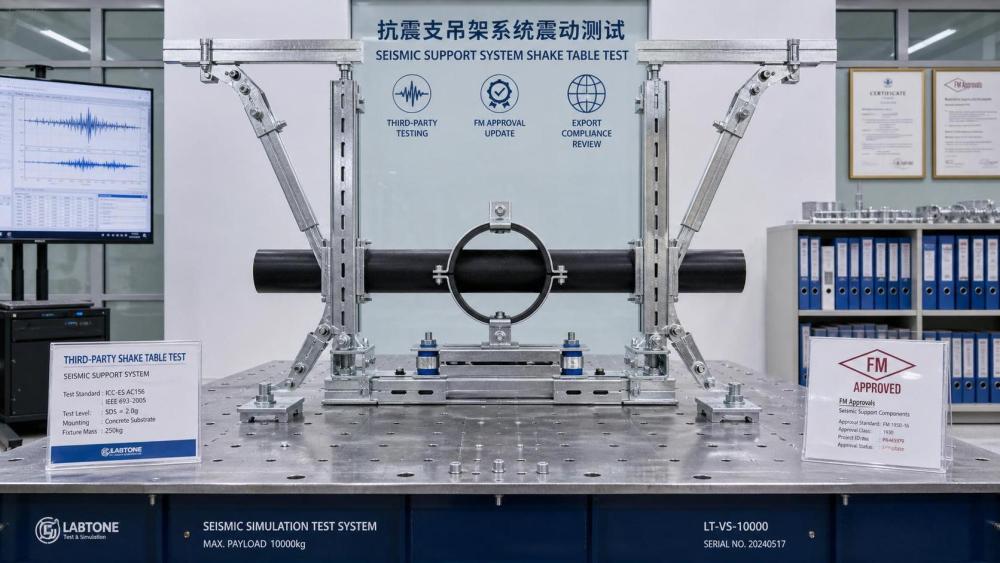
According to the provided information, FM Global released Rev. 4.2 of the Seismic Bracing Systems Certification Guidelines on June 21, 2026. The update states that all Seismic Bracing Systems applying for FM certification, including hangers and lateral or longitudinal restraint components, must provide a third-party shake-table test report. The report must verify nonlinear displacement response and connector fatigue life under an Mw7.0 earthquake spectrum. The update is described as affecting the certification strategy and testing cost of Chinese seismic bracing manufacturers exporting to the United States, with particular relevance for products using modular pre-assembly processes.
Where the new requirement may reshape business workflows
Export programs may need earlier certification planning
From an industry perspective, exporters of seismic bracing products may be affected first because FM certification is tied to market access expectations in relevant projects. The practical impact may appear in pre-export technical review, certification scheduling, document readiness, and coordination between product design and test evidence. What deserves closer attention is whether existing product files and application packages are sufficient once third-party dynamic verification becomes a required part of submission.
Manufacturing teams may face closer scrutiny of assembled products
Analysis shows that the update matters not only for individual components but also for system-level configurations that are presented for certification. This is especially relevant for manufacturers using modular pre-assembly methods, because the required verification focuses on nonlinear displacement response and connector fatigue life under a specified seismic spectrum. In practice, production, engineering, and quality teams may need to pay closer attention to whether the certified configuration, connection method, and delivered product form remain aligned.
Testing and certification service workflows may become more central
Certification-related service providers and testing organizations may see a greater role in supporting application preparation, because third-party shake-table reports are explicitly required in the provided summary. The likely impact is concentrated in report preparation, technical file completeness, evidence consistency, and communication of test scope during certification review. For applicants, this raises the importance of document control and traceability rather than treating testing as a late-stage formality.
Procurement and project-side reviews may tighten document checks
For buyers, contractors, and specification reviewers involved in projects that rely on FM-certified products, the rule change may affect how supplier qualifications and technical submissions are assessed. Observably, procurement attention may shift toward whether suppliers can present complete third-party verification materials, whether product claims match certified assemblies, and whether delivery documentation remains consistent with the tested system.
What companies should watch next in practical terms
Recheck certification files against the new evidence threshold
Analysis shows that companies currently pursuing or planning FM certification should review whether their existing application materials already address the newly stated third-party dynamic test requirement. This is less about broad compliance language and more about whether the supporting technical evidence is structured for the updated certification expectation.
Compare product configuration with tested configuration
What deserves closer attention is the relationship between the actual delivered product and the product form represented in testing and certification documents. For modular pre-assembled systems in particular, companies may need to examine whether assembly methods, connection details, and system combinations are described consistently across technical documents, test reports, and certification submissions.
Account for possible effects on cost and lead time
Observably, the provided summary already points to pressure on certification strategy and testing cost, especially for Chinese manufacturers exporting to the United States. Companies may therefore need to monitor whether additional testing, file revision, or certification sequencing could influence quotation timing, procurement planning, or shipment preparation. Since the input does not provide implementation details, this should be treated as a compliance planning issue to watch rather than a confirmed outcome for all projects.
Track downstream wording in bid and supply documents
From an industry perspective, another practical point is how this update may later appear in bid specifications, supplier qualification checklists, customer technical requirements, and post-award document review. Even without further confirmed details in the input, companies involved in sales, exports, and project delivery may benefit from watching for changes in document language and certification evidence requests.
Why this looks like an execution signal rather than a broad policy headline
Analysis shows that this update is more meaningful as a certification execution signal than as a general industry statement. The reason is that it narrows attention to a specific proof requirement: third-party shake-table validation of nonlinear displacement response and connector fatigue life under a defined seismic spectrum. It is more appropriate to understand this as a rule change with immediate documentary and testing relevance for affected certification pathways, while some questions about implementation pace and market response still require observation.
How the market is likely to read this update for now
At this stage, the update is best understood as a concrete tightening of certification evidence expectations for Seismic Bracing Systems rather than a purely symbolic revision. For manufacturers, exporters, procurement participants, and certification support teams, the main issue is not only the wording of the guideline but also how quickly product documentation, testing arrangements, and supply commitments can be aligned with it. A cautious reading is appropriate: the change is already defined in the provided summary, but its full commercial impact still depends on how certification reviews, customer requirements, and project-side checks develop in practice.
Basis of this article and what still needs verification
This article is based on the user-provided title, event date, and event summary. For developments of this type, relevant source categories usually include official announcements, certification body publications, regulatory releases, trade authority information, industry association updates, standard-setting documents, and reporting by authoritative trade media. The specific official source link was not provided in the input, so further verification is still needed. What should continue to be monitored includes detailed implementation language, certification review practice, changes in bid documents, industry feedback, and how affected companies adjust execution at the product and export level.
Structural Safety Fellow
Related News
- 00
0000-00
How to Qualify a Seismic Bracing for Piping Manufacturer for Code-Compliant Projects - 00
0000-00
What FM Approval Means When Buying Seismic Pipe Support Systems - 00
0000-00
MEP Seismic Support Hanger Layout Rules for Multi-Service Ceiling Zones - 00
0000-00
How Adjustable Seismic Pipe Hangers Simplify Alignment During Installation - 00
0000-00
Seismic Restraint for Piping: Design Checks for High-Risk Building Systems
0000-00
Weekly Insights
Stay ahead with our curated technology reports delivered every Monday.