Share
GILE 2026 Closes as Smart Boards Draw Buyers

GILE 2026, held from June 9 to June 12 and closing on June 12 in Guangzhou, pointed to a sharper procurement focus on smart distribution boards among buyer groups from the Middle East and Southeast Asia. For manufacturers, exporters, compliance teams, and project-facing sales functions, the development is worth watching because the discussion is not only about product demand, but also about whether suppliers can meet increasingly specific requirements on monitoring, remote control, flame-retardant housing, and certification documents.
What the exhibition data confirmed
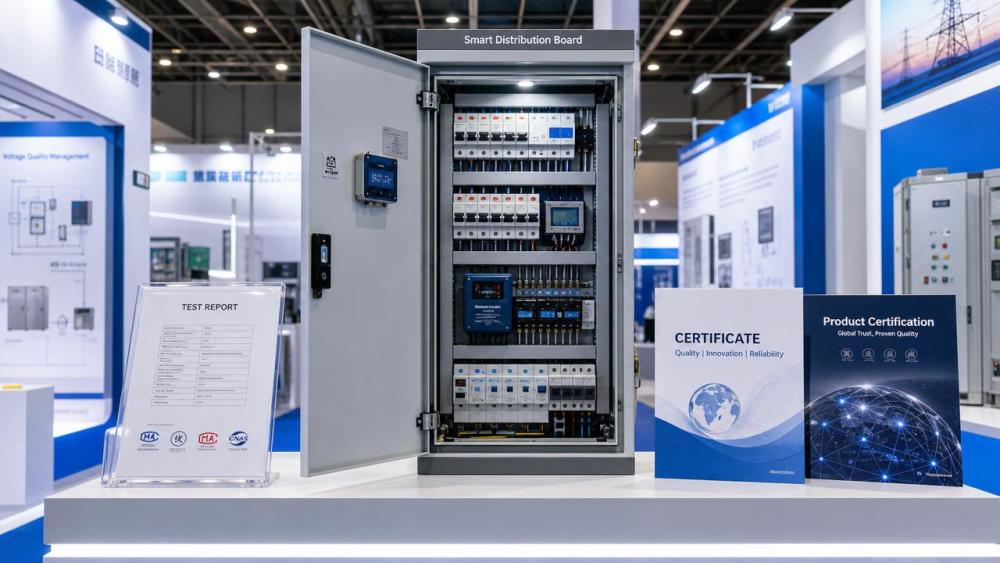
According to data released at the close of GILE 2026, inquiries for smart distribution boards from procurement groups in Saudi Arabia, the UAE, Vietnam, and the Philippines rose 217% year on year. The stated driver was that newly built data center and green hospital projects in those markets commonly require integrated power quality monitoring, remote branch circuit control, and UL94 V-0 flame-retardant enclosures.
Multiple Chinese exhibitors also reported that customers explicitly asked for IEC 61439-3 type test reports and sample units carrying both UL and IEC certifications. These points define the confirmed facts disclosed through the exhibition summary and exhibitor feedback.
Why this matters across the supply chain
Export-facing manufacturers may face a higher proof threshold
From an industry perspective, the immediate impact is likely to fall on manufacturers and trading companies serving overseas projects. The issue is not only whether a smart distribution board can be offered, but whether supporting documentation, sample preparation, and specification matching can keep pace with buyer expectations in active project channels.
Component and enclosure sourcing may become more specification-led
For procurement and supply chain teams, the emphasis on integrated monitoring, remote branch control, and UL94 V-0 housing suggests that material selection and subsystem matching may receive more scrutiny during quotation and sample stages. What deserves closer attention is how product configuration and compliance evidence are aligned before customer engagement deepens.
Project buyers and service partners may tighten pre-qualification
For project buyers, distributors, and technical service providers, the reported requests indicate that pre-qualification may increasingly depend on verifiable test reports and certification readiness. In practical terms, communication may shift earlier toward document availability, sample conformity, and application-specific suitability rather than price discussion alone.
What companies should track now
Document readiness before quotation cycles move forward
Analysis shows that IEC 61439-3 type test reports are becoming a core conversation point in these transactions. Companies involved in overseas bids or buyer development should pay close attention to whether their current documentation set is complete, current, and usable in customer-facing exchanges.
Certification alignment for target export markets
The request for UL and IEC dual-certified samples is a practical signal rather than a broad market claim. Companies targeting Saudi Arabia, the UAE, Vietnam, and the Philippines should closely review whether product samples, test records, and labeling materials are consistent with the certification expectations raised during the exhibition.
Product communication around functional requirements
Observably, buyers are asking about specific functions: power quality monitoring, remote branch circuit control, and UL94 V-0 flame-retardant housings. Sales and technical teams may need to present these capabilities more clearly and distinguish between standard configurations, optional functions, and documented compliance status.
Delivery planning tied to samples and approvals
Where customer discussions depend on sample submission and compliance review, supply chain and delivery teams should watch for longer front-end coordination needs. The key business issue is not only shipping product, but preparing the right sample and paperwork set at the right stage of negotiation.
How this signal should be read
Analysis shows that this development is better understood as a concrete demand signal rather than a finished market conclusion. The inquiry increase at GILE 2026 indicates that smart distribution boards are moving closer to project specification discussions in parts of the Middle East and Southeast Asia, especially where data centers and green hospitals are involved. At the same time, it is still a show-based signal supported by exhibitor feedback, so the industry should continue to watch whether inquiry momentum converts into repeat orders, qualification progress, and stable specification trends.
A practical takeaway for the market
The main significance of this update is that overseas buyer attention appears to be concentrating on measurable product capability and compliance readiness, not only on the general category of smart distribution boards. For industry participants, the more appropriate conclusion at this stage is that the market is sending a clearer requirements signal, especially around testing, certification, and function integration, and that this deserves close follow-up rather than overstatement.
Basis of this article
This article is generated based on the user-provided news title, event time, and event summary. Information of this kind is commonly cross-checked against sources such as official exhibition releases, company statements, industry association updates, authoritative media coverage, and standard organization documents. A specific official source link was not provided in the input, so further verification remains necessary. What deserves continued attention is whether later disclosures provide more detail on order conversion, certification practice, and project-side procurement criteria in the referenced markets.
Power Distribution Architect
Related News
- 00
0000-00
How to Evaluate a Building IoT Monitoring Supplier for Multi-Site Projects - 00
0000-00
How IoT Condition Monitoring Reduces Unplanned Downtime in Critical Facilities - 00
0000-00
High-Rise Electrical Distribution Design: Key Load, Riser, and Protection Decisions - 00
0000-00
Smart Building Monitoring Cost: Budgeting Sensors, Software, and Lifecycle Support - 00
0000-00
Electrical Distribution Equipment Maintenance: A Preventive Checklist for Safer Uptime
Weekly Insights
Stay ahead with our curated technology reports delivered every Monday.